BWS AMATEUR RADIO CLUB
Content on this page was created and archived before the ADA Title II mandate for WCAG 2.1 Level AA content and will not be updated.
To request special assistance to review or inspect an archived document, call (808) 748-5041, email a detailed request to contactus@hbws.org or submit a request for information form.
Archive
April 30, 2021
Simulated Emergency Tests BWS Amateur Radio Readiness
Throughout the year, thousands of licensed amateur radio operators across the United States participate in emergency communications (EMCOMM) training in their local and state communities. Each October, the Amateur Radio Relay League (ARRL) encourages affiliated clubs and communities across the nation to conduct simulated emergency exercises and to ensure their readiness for a disaster situation. The Honolulu Board of Water Supply (BWS) is no exception. BWS began participating in annual Simulated Emergency Training (SET) exercises in 2019 after it hosted a voluntary class for employees to prepare for an amateur radio license exam through the Federal Communications Commission (FCC).
“I began exploring ham radio as a personal hobby almost two years ago,” said Ernest Lau, BWS Manager and Chief Engineer, and a General amateur radio license holder. “As I learned more about it, I realized just how important amateur radio could be for EMCOMM, not only on a personal level for my family, but also for secondary or redundant communications for the agency and our community if, in the worst of disasters, all primary communications went down.”
Once we had a group of newly licensed operators, we knew we had to keep the momentum going by offering opportunities to practice and hone their skills.”
—Ernest Lau, BWS Manager (WH6GAJ)
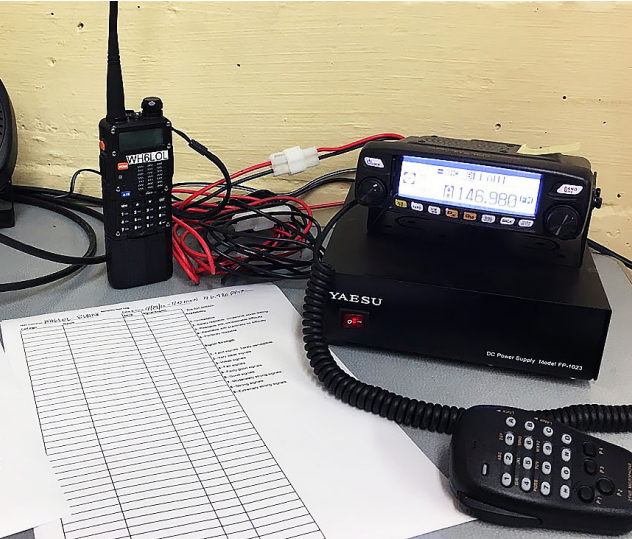
For the 2020 SET at the BWS, licensed amateur radio operators participated in simulated exercises over a two-day period to practice basic operator skills in simplex and data transmission modes using handheld, mobile, or home-based radio equipment. More than half of the agency’s 30 licensed operators volunteered to participate in the SET, which simulated the aftermath of a simulated hurricane. For some first-time participants, the experience was an eye-opening one. Steven Norstrom earned his Technician license in February 2020 as part of the second BWS training class. The Technician license is the entry-level license for amateur radio operators in the United States.
“(It) helped me see the big picture of what could happen when a disaster strikes and showed me the importance of radio communications in sharing information during a chaotic situation,” said Norstrom, an Information Specialist II in the BWS Communications Office.
In an emergency, communications will usually follow a “hub-and-spoke” approach, where information is relayed from operators in the field to designated base stations that then relay messages to hub stations for further action or situational awareness. This approach helps to keep the flow of information moving as efficiently as possible from the field to emergency operations centers.
The first day of the 2020 SET focused on simplex communications, with operators transmitting via their radios from the field to a base station and from a base station to a hub station. Participants simulated both the in-field and base station operator roles. Participants practiced their on-air skills – operator etiquette, procedural words, and ITU phonetics – as well as with a back-up method of recording and relaying messages—pen and paper. To add to the overall experience and to help simulate urgency, all operators were asked to complete a set of tasks in a short sprint of 15-20 minutes. These practical and hands-on skills are crucial in a disaster, especially if communication networks (mobile, landline, and internet) and other key infrastructure systems are temporarily offline or rendered inoperable.
“Being on the air feels a bit awkward at first, but that feeling goes away as you get more experience,” said Brian Haruna, an Electrical Engineer III with the BWS Capital Projects Division. “One of the more challenging aspects of the hobby is becoming comfortable with the terminology that is expected to be used. These standardized words and phrases make it easier to understand incoming messages, which may be difficult to hear. The SET exercises and other opportunities to go on the air allow us to practice using these words so that we know what and how to relay messages without having to spend time trying to decipher them.”
Haruna was among 20 BWS employees in July 2019 to earn their first amateur radio licenses. Since then, Haruna has upgraded his General class license to an Amateur Extra one – which is the top license available in the U.S. and gives him operator privileges on all U.S. amateur radio bands. And, he is now able to support the local amateur radio community as one of five licensed ARRL Volunteer Examiners (VEs) working at the BWS.
“What BWS is doing is really above and beyond my expectations when I first signed up to take the licensing exam,” Haruna said. “We have access to various types of radio and communication equipment, from satellite phones to hand-held radios and base stations. Recently we even began transmitting email through the airwaves. This is just the beginning as we are working to expand our communication network capabilities and increase our number of licensed operators.”
Haruna helped to coordinate the second day of the 2020 SET, which focused on using Winlink to transmit post-disaster messages via email over amateur radio frequencies. This gave the group of data transmission participants a safe environment to set up Winlink stations in advance either at home or for field use, and then to test and troubleshoot connectivity and to transmit and receive messages in a simulated post-disaster scenario.
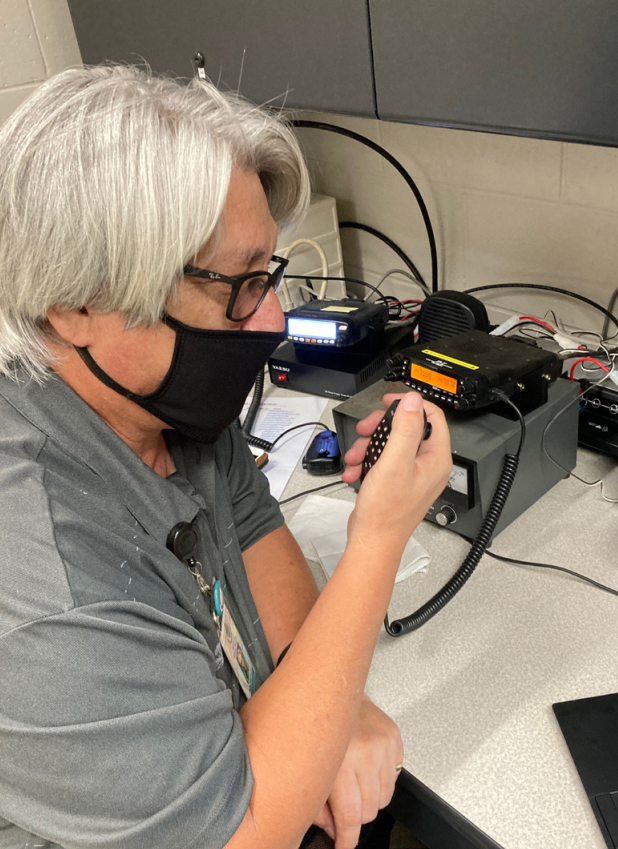
Amateur operators relayed messages to and from the BWS Manana Yard and Beretania St. during Hurricane Douglas (July 2020)
Essential Life Skills
For some licensed operators like Blaine Fergerstrom, an Information Specialist II at BWS, emergency preparedness is a life-long skill started during his years in Boy Scouts and through his years in the Navy. Fergerstrom credits the Boy Scouts for his interest in preparedness training, first aid, self-reliance and adaptability, flag communications, morse code, lifesaving and other emergency skills, and the Navy for training in firefighting, first aid, damage control, and EMCOMM.
“Knowing how to respond in case of disaster has always been important to me ever since I was a young boy,” said Fergerstrom. “And it continues today with my CERT (Community Emergency Response Team) certification, my first aid and CPR certification, and my Technician-class HAM license. Drills like the October SET give you practice at using the various communications tools available to you in the event that normal mass communications systems, like telephones or the internet, become inoperable. It’s just that essential.”
According to Manager Lau, it was humbling to see the BWS employees take such an interest in amateur radio and to become more invested personally in emergency communications.
“We have more than 30 licensed operators now, and whether it’s for day out hiking or camping, or for that fishing trip at sea, or for improving the family’s disaster preparedness kit, amateur radio is something that can keep us connected in an emergency,” Lau said. “That makes participating in simulated emergency exercises and supporting a resilient amateur radio infrastructure in Hawaiʻi important parts of our commitment to emergency readiness.”
April 13, 2021
COMM Academy Emergency Communications Workshop
COMM Academy conducted an emergency communications workshop this past weekend. Watch below.
April 13, 2021
ARLB011 Updated Radio Frequency Exposure Rules Become Effective on May 3
ZCZC AG11
QST de W1AW
ARRL Bulletin 11 ARLB011
From ARRL Headquarters
Newington CT April 13, 2021
To all radio amateurs
SB QST ARL ARLB011
ARLB011 Updated Radio Frequency Exposure Rules Become Effective on May 3
The FCC has announced that rule changes detailed in a lengthy 2019 Report and Order governing RF exposure standards go into effect on May 3, 2021. The new rules do not change existing RF exposure (RFE) limits but do require that stations in all services, including amateur radio, be evaluated against existing limits, unless they are exempted. For stations already in place, that evaluation must be completed by May 3, 2023. After May 3 of this year, any new station, or any existing station modified in a way that’s likely to change its RFE profile – such as different antenna or placement or greater power – will need to conduct an evaluation by the date of activation or change.
The Report and Order can be found online in PDF format at https://docs.fcc.gov/public/attachments/FCC-19-126A1.pdf.
“In the RF Report and Order, the Commission anticipated that few parties would have to conduct reevaluations under the new rules and that such evaluations will be relatively straightforward,” the FCC said in an April 2 Public Notice. “It nevertheless adopted a 2-year period for parties to verify and ensure compliance under the new rules.”
The Amateur Service is no longer categorically excluded from certain aspects of the rules, as amended, and licensees can no longer avoid performing an exposure assessment simply because they are transmitting below a given power level.
“For most amateurs, the major difference is the removal of the categorical exclusion for amateur radio, which means that ham station owners must determine if they either qualify for an exemption or must perform a routine environmental evaluation,” said Greg Lapin, N9GL, chair of the ARRL RF Safety Committee and a member of the FCC Technological Advisory Council (TAC).
“Ham stations previously excluded from performing environmental evaluations will have until May 3, 2023, to perform these. After May 3, 2021, any new stations or those modified in a way that affects RF exposure must comply before being put into service,” Lapin said.
The December 2019 RF Report and Order changes the methods that many radio services use to determine and achieve compliance with FCC limits on human exposure to RF electromagnetic fields. The FCC also modified the process for determining whether a particular device or deployment is exempt from a more thorough analysis by replacing a service-specific list of transmitters, facilities, and operations for which evaluation is required with new streamlined formula-based criteria. The R&O also addressed how to perform evaluations where the exemption does not apply, and how to mitigate exposure.
Amateur radio licensees will have to determine whether any existing facilities previously excluded under the old rules now qualify for an exemption under the new rules. Most will, but some may not.
“For amateurs, the major difference is the removal of the categorical exclusion,” Lapin said, “which means that every ham will be required to perform some sort of calculation, either to determine if they qualify for an exemption or must perform a full-fledged exposure assessment. For hams who previously performed exposure assessments on their stations, there is nothing more to do.”
The ARRL Laboratory staff is available to help amateurs to make these determinations and, if needed, perform the necessary calculations to ensure their stations comply. ARRL Laboratory Manager Ed Hare, W1RFI, who helped prepare ARRL’s RF Exposure and You book, explained it this way. “The FCC did not change any of the underlying rules applicable to amateur station evaluations,” he said. “The sections of the book on how to perform routine station evaluations are still valid and usable, especially the many charts of common antennas at different heights.” Hare said ARRL Lab staff also would be available to help amateurs understand the rules and evaluate their stations.”
RF Exposure and You is available in PDF format for free download from ARRL at http://www.arrl.org/files/file/Technology/RFsafetyCommittee/28RFSafety.pdf
ARRL also has an RF Safety page on its website at http://www.arrl.org/rf-exposure.
The ARRL RF Safety Committee is working with the FCC to update the FCC’s aids for following human exposure rules – OET Bulletin 65 and OET Bulletin 65 Supplement B for Radio Amateurs. In addition, ARRL is developing tools that all hams can use to perform exposure assessments.
NNNN
/EX
April 8, 2021
NOAA-NWS - SKYWARN Spotter Training
From the National Weather Service Honolulu office – FREE SKYWARN Spotter Training
Aloha Spotters!
It is that time of year again for initial/refresher SKYWARN spotter training provided by the National Weather Service Honolulu office. Because of the ongoing pandemic, we will be conducting the training virtually this year via GoToWebinar on Thursday, May 20, 2021 at 6pm.
Training should take about 2 ½ hours with Q & A and some additional discussion with Kevin Bogan, AH6QO, SKYWARN HAM Coordinator. After registering, you can join us through the provided link or phone number that will be automatically emailed to you.
Register here: https://attendee.gotowebinar.com/register/7372002677537685517
Feel free to pass this invite to family, friends or someone you think may be interested in becoming a SKYWARN spotter. We will also record this presentation and provide a link through our spotter email list for you to view if you cannot make the training session. Yes, you will get the same credit for attending the live or recorded session. Once completed, email matthew.j.foster@noaa.gov with the following information:
- Full name
- Home address
- HAM call sign (if applicable)
- Phone number(s)
- Hours available for a weather report (i.e. 8am-8pm)
- Date you trained
- If you’re a new spotter or if this is refresher training (provide your SKYWARN ID #)
Kevin Bogan asks those Amateur Radio operators interested in reporting their Severe Weather Reports (SWR) during an activation to please send him an email (as well) stating so to kevin.bogan@gmail.com. Please include your given name, surname, call sign, Spotter number, date last trained and primary location from which you might be reporting.
Your email address will be used to receive announcements of radio training opportunities as well as notification of Skywarn HAM activations and AAR. Zoom meetings for radio training, “hot wash” and other discussions. The radio training will focus on the reporting format and how it is passed on air and through Winlink or FLDIGI.
We would also like to invite you to watch our recorded 2019 SKYWARN training session that will cover many of the same topics: https://www.youtube.com/watch?v=AlttvKlyPFk&ab_channel=NWSHonolulu
Thanks,
Matthew Foster, Meteorologist, National Weather Service Honolulu
Kevin Bogan, AH6QO, SKYWARN HAM Coordinator
Regards,
Bob
Robert H-H Harter
HAZMAT Officer
Department of Emergency Management
City and County of Honolulu
650 South King Street
Honolulu, HI 96813
(O) 808-723-8958
(E) rharter@honolulu.gov
(W) www.honolulu.gov/dem
Sep 5 2020
It's Official: KH6BWS BWS ARC Call Sign
We got word from the FCC today that our request for KH6BWS as our club call sign was granted.
July 29, 2020
New Net Control for EARC Nightly Net
Just an FYI that this Thursday, July 30, 2020, the EARC nightly Net will be led by none other than WH6LOL (Blaine Fergerstrom). Please support his debut at Net control by checking into the Thursday net!
Aloha and 73,
Stella
WH6GDM
May 19, 2020
BWS ARC Weekly Net
The BWS ARC Weekly Net is run off the linked DEM repeaters every Wednesday at 12:00 noon. The net generally runs from the BWS Beretania DOC (Disaster Operations Center) but may also be conducted from other locations on the same repeaters. The net is first opened to emergency traffic, then BWS licensed amateur operators, followed by any other licensed operators. At this time, the net features only check-ins with call-sign, name, repeater, and physical location, but no round-table. Brief comments may be allowed, if time permits.
May 5, 2020
Weekly Hawaiʻi Mainland Overseas Allstar Net
From: Dave P
Subject: Weekly Hawaiʻi Mainland Overseas Allstar Net
Aloha All,
Please join us Sunday afternoon for our weekly emergency communications net at 4:00PM (HST) Hawaiʻi Standard time on the Hawaiian Mainland Allstarlink Network. All radio amateurs are invited. This network has a big footprint, and good ears with multiple remote Allstar simplex and repeater nodes, so hams on every island and on the Mainland should be able to check in.
- Weekly Newsline Broadcast Sunday 03 May 2020 at 1530 Hawaiʻi Standard Time (Monday 0130 UTC 04 May)
- Weekly Net starts Sunday at 1600 Hawaiʻi Standard Time
- Net Control: Gescio (WH6AV) – Wailuku, Maui
Allstar – Hawaiʻi/Mainland Allstarlink Network via RF simplex and repeaters throughout the Hawaiian Islands and nodes in the Mainland. Here is a link to view the RF frequencies depending upon where you reside:
DMR/Brandmeister Network on 31158 Hawaiʻi Mainland Allstar time slot 1
- Echolink
- WH6AV-R
- NH6HI-L
- KH6IN-L
For those not licensed yet, you can listen to the net on the following website.
If anyone needs help, please let me know. Glad to be of assistance
73 and aloha,
Dave – AH6OD
tdydave@gmail.com
Feb 14, 2020
Monitoring HF Bands on AH6GT Website
From: wh6ecg
Sent: Thursday, February 13, 2020 9:13 PM
Subject: Monitoring HF bands on AH6GT website
Hi everyone,
Sharing a tip for monitoring local HF bands:
AH6GT Konabob has a very useful website (link below) with Hawaiʻi ham radio links. I want to draw your attention to one aspect: listening online to HF bands associated with the 9am and 4pm (HST) daily HF Aloha nets. At the bottom of the linked page there are links to a Maui HF station and a Kaneohe HF station. By clicking on the frequency button you can listen to streaming audio of that frequency at any time. Why I like this feature:
- Those with HF radios can listen to how the band sounds as received in Kaneohe or on Maui at any time. Just tune your radio to the appropriate frequency; select the frequency to monitor; and give a test voice transmission. It can help adjust your audio features or gain a better sense of how your signal is being received on Maui or in Kaneohe. This is a great way to get instant feedback on your microphone gain, power setting, antenna comparisons, or just propagation conditions. Lately the evening NVIS propagation tends to be on 80m and 160m, rather than on 40m.
- For those without HF radios or for those who cannot put up a 40m / 80m / 160m antenna, you can listen to the band from the Maui or Kaneohe station through the streaming audio. Works anywhere you have internet access. Again, this is listening only – not transmitting.
https://www.konaweb.com/net/left.html
The web site has plenty of other great links, and Konabob is frequently refining the page as a tool to help Hawaiʻi hams, but I wanted to highlight these HF monitoring tools.
Have a great weekend!
Aloha,
Evan WH6ECG
Windward Oʻahu ARES Emergency Coordinator
Dec 10 2019
Oʻahu Board of Water Supply Realizes the Merits in Amateur Radio
Author: KH6OWL, Honolulu, Hawaiʻi
In a recent interview with the Honolulu Board of Water (BWS) supply we sat down with Ernest Lau, WH6GAJ & Manager and Chief Engineer at BWS, Ms. Kathleen Elliot-Pahinui, Information Officer (IO), Stella Bernardo, WH6GDM, IS II and Ham Coordinator and Raleigh Ferdun, KH6EN, to discuss their involvement with amateur radio. (Raleigh is not an employee of the BOW)
The Board of Water Supply (BWS) recently encouraged their employees to take an amateur radio class and to get their license. The class was held during the work day and taught by Raleigh, KH6EN. It was voluntary and to encourage employees, the initial license fee was paid by the BWS for the employees who take the exam. The BWS also loaned the class books to all attendees. The classes were held at the BWS.
Sep 12 2019
Simulated Emergency Radio Exercise 2019
Hi everyone!
In lieu of a meeting on Friday, October 4, we plan to conduct an emergency radio exercise with the Pacific Section of the ARRL. The exercise is tentatively scheduled to occur between 10:00 AM to 2:00 PM that day. As we are working out the details, we ask that everyone respond to the following survey no later than Friday, September 13.
- Emergency Radio Exercise Survey (Licensed BWS operators only)
For those of you interested in participating, you do not need to be available during the whole time. We will be earmarking time per person during the morning and during the afternoon to participate. We are working rapidly on several amateur radio operator fronts, so if you have questions, please let me know.
This is very exciting!
Stella
WH6GDM
Sep 9 2019
Grid Madness 2019
For those who might be interested in the Grid Madness 2019, here is the grid map of Oʻahu, Maui, and Big Island. Have fun: download Hawaiʻi Grid Map PDF
Kenrick
KH6KO
June 19, 2020
Amateur Radio Resources
Basics / Operator Tips (PDF)
- Amateur Radio Basics (04/2009)
- How to Sound Like a Pro When Operating on a Repeater
- Procedural Words, Phonetics & Voice Exercises
- Ron Hashiro – Phraseology for Radio Communications During Emergencies
Websites
- American Radio Relay League (ARRL)
- Emergency Amateur Radio Club of Hawaiʻi (EARC)
- Hawaiʻi Amateur Radio Emergency Service (Hawaiʻi ARES)
- QRZ Ham Radio Call Sign Database
- Pacific Section of ARRL
- Ham Radio Hawaiʻi